
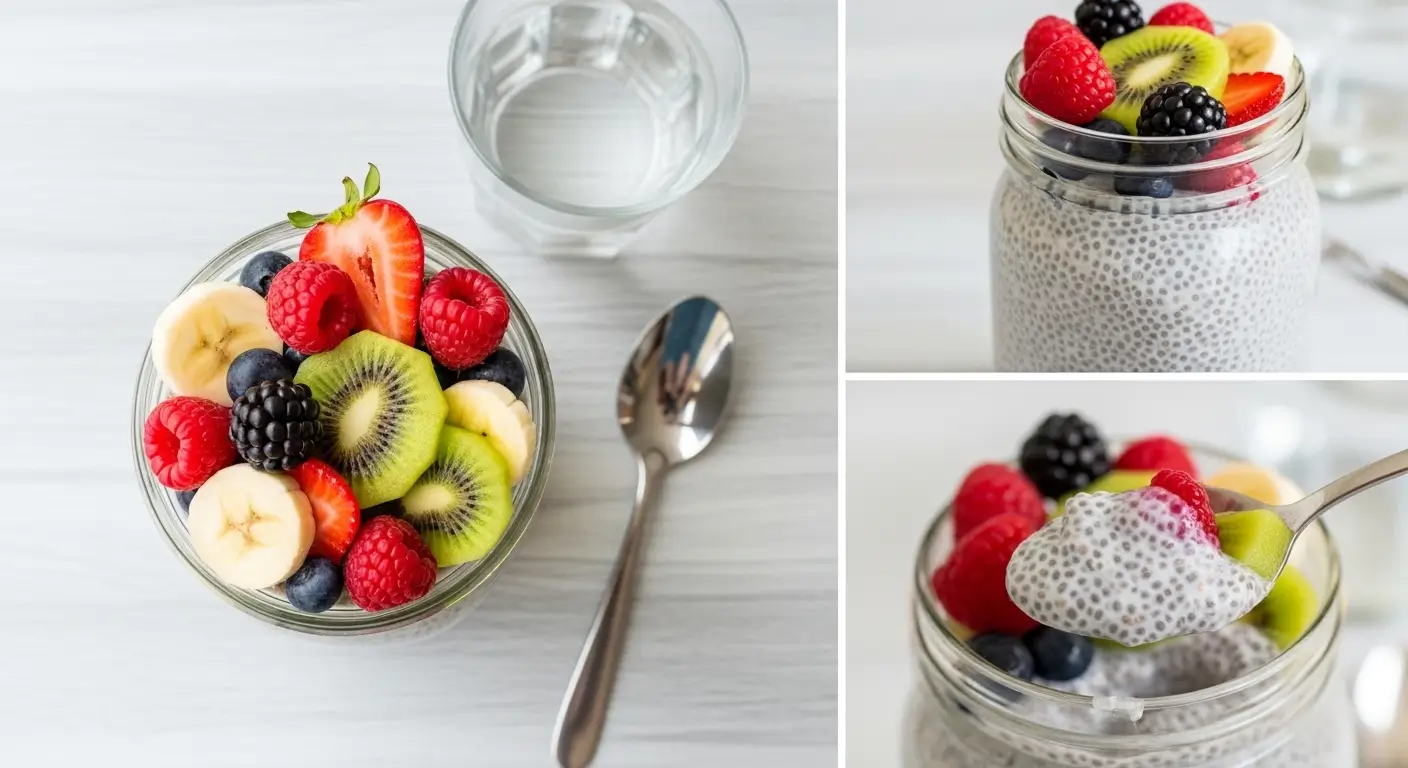
Low calorie chia pudding entered my life during what I can only describe as a January of reckoning. You know the kind. The holidays had been generous. I had been generous with myself during the holidays. And then January arrived and my favorite jeans had opinions about that generosity and those opinions were not flattering.
I wasn’t looking for a miracle. I wasn’t doing a cleanse or a detox or anything with a number of days attached to it. I just wanted a breakfast that was actually filling, actually tasted good, and wasn’t quietly destroying my calorie situation before 9am. Because that had apparently been happening. Quietly. For months.
My friend Nadia had been making chia pudding for a while and kept posting pictures of it that I’d been scrolling past with mild interest. And then one Tuesday in January I texted her at 7am like “okay fine tell me everything.” She sent back a voice note that was four minutes long. I listened to all of it standing in my kitchen in my coat because I hadn’t even taken it off yet.
I made my first batch that night. It was okay. Good base, right idea, but I was still adding too much of everything — too much sweetener, too much nut butter on top, too many granola clusters that were, it turned out, extremely calorie dense. The bowl I was proudly calling “healthy” was sitting at around 450 calories. That’s not a low calorie breakfast. That’s just regular breakfast wearing a wellness costume.
So I figured out how to actually make it work. And that’s what this is.
Also check : Almond Milk Chia Pudding — The Recipe I Almost Gave Up On (And Then Couldn’t Stop Making)
What Low Calorie Actually Means Here — Let’s Be Real
Before anything else I want to be straight with you about numbers because I think vague “healthy” claims are annoying and unhelpful.
A properly made low calorie chia pudding — base plus thoughtful toppings — comes in between 180 and 220 calories per serving. That’s for a filling, genuinely satisfying bowl that holds you for three to four hours. Not a tiny sad portion. A real breakfast.
The standard chia pudding recipe with full-fat coconut milk, maple syrup, granola, and nut butter? Easily 400 to 500 calories. Which is fine if that’s what you’re going for. But if you’re specifically trying to manage calories without feeling like you’re being punished, there are specific swaps that bring that number way down without making the breakfast worse. Some of the swaps actually make it better, which surprised me.
The low calorie chia pudding strategy comes down to four things: the right milk, the right sweetener approach, the right chia seed quantity, and the right toppings. Get all four right and you have a breakfast that fits your goals and tastes good. Get one wrong and you’re either hungry by 10am or eating something that makes you sad. Neither of those is acceptable. We deserve better than that.
The Milk Decision — This Is Where Most Calories Hide
In a standard chia pudding recipe the milk is the biggest calorie variable. Full-fat canned coconut milk — which makes the most luxurious, thick chia pudding — runs about 230 calories per cup. That’s before you’ve added a single chia seed.
For low calorie chia pudding we need to be smarter about the milk choice. Here’s my honest ranking:
Unsweetened almond milk: 30 to 40 calories per cup depending on brand. This is the lowest calorie option and my weekday go-to. It’s light and slightly nutty and perfectly fine as a chia pudding base when you handle the flavor properly with vanilla and other additions. Silk unsweetened original is what I use most often.
Unsweetened oat milk: About 60 to 80 calories per cup. Slightly higher than almond milk but still very reasonable, and it has natural sweetness from the oats that means you need less added sweetener — which often means the total calories end up comparable. Oatly unsweetened is my choice here.
Unsweetened cashew milk: Around 25 to 40 calories per cup. Creamier than almond milk with a more neutral flavor. Actually my favorite for low calorie chia pudding texture-wise because it makes the finished pudding feel richer than the calorie count would suggest. Harder to find than almond milk but worth it when I can get it.
Light coconut milk from a can: About 75 to 90 calories per cup — significantly less than full-fat but still gives you that coconut richness and the thicker texture that full-fat provides. This is my compromise option when I want something more indulgent but still need to keep calories reasonable.
What to avoid: Full-fat canned coconut milk for everyday low calorie chia pudding. Also any sweetened plant milk — those have added sugar calories that add up fast and you lose control of the sweetness level.
What You Need
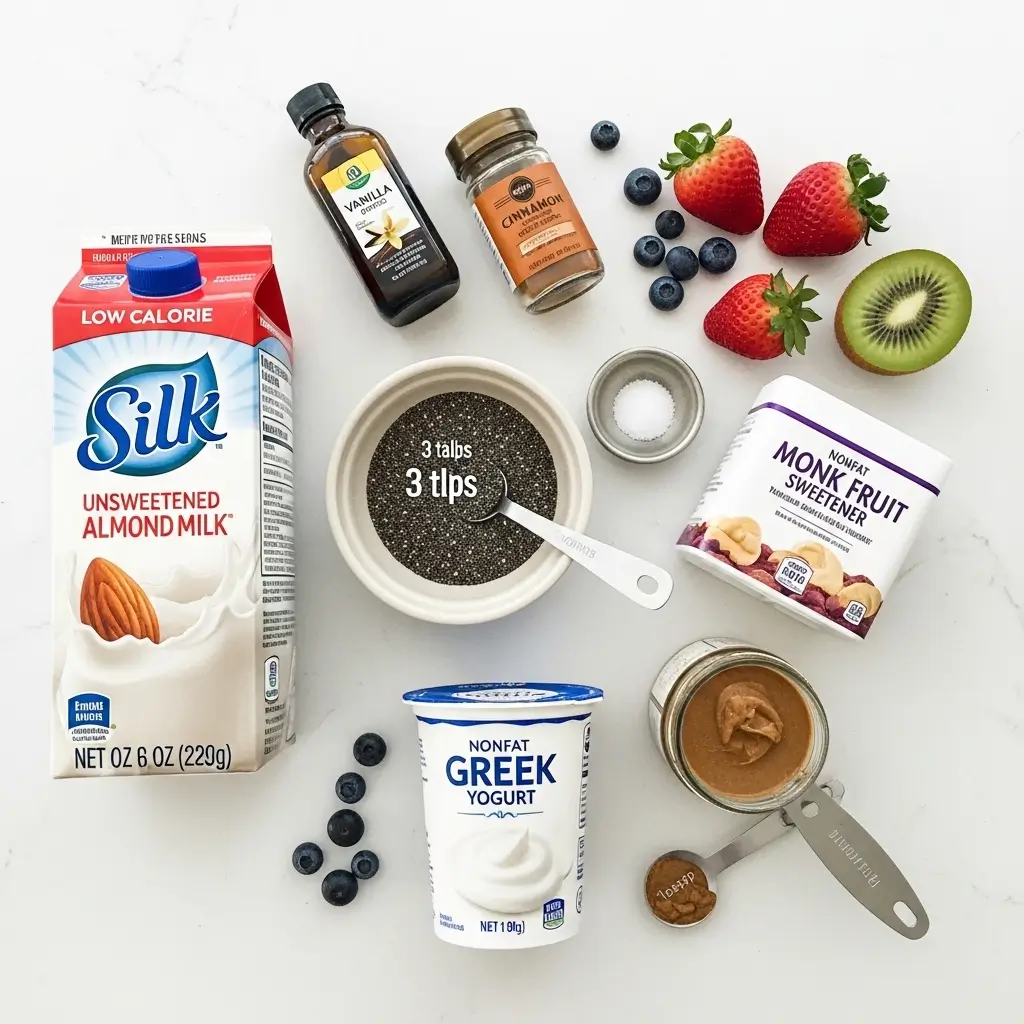
For 2 servings of genuinely low calorie chia pudding:
- 1 cup unsweetened almond milk or unsweetened cashew milk
- 3 tablespoons chia seeds — yes, 3 not 4, I’ll explain this below
- 1 teaspoon vanilla extract — real vanilla, a full teaspoon
- 1/4 teaspoon cinnamon
- Pinch of salt
- Optional sweetener: a few drops of liquid stevia OR 1/4 teaspoon monk fruit sweetener — both are zero calories
- Optional: 2 tablespoons plain nonfat Greek yogurt stirred in — adds creaminess and protein for about 10 extra calories, genuinely worth it
Low calorie toppings that actually work:
- Fresh berries — strawberries, raspberries, blueberries. About 40 to 50 calories for a generous handful. High volume, naturally sweet, makes the bowl look abundant
- Sliced kiwi — underrated, slightly tart, beautiful green color, about 42 calories per kiwi
- Sliced banana — half a banana, about 50 calories, adds natural sweetness and creaminess
- A teaspoon of honey — yes, just a teaspoon, not a drizzle-until-you-feel-like-stopping, about 21 calories
- Unsweetened coconut flakes — a tablespoon, about 18 calories, adds texture and a subtle sweetness
- A tablespoon of low fat granola — pick carefully here, some granola is extremely calorie dense, look for options under 100 calories per quarter cup
- A teaspoon of nut butter — just one teaspoon, about 30 to 35 calories, adds richness and keeps you fuller longer
Toppings I had to stop using:
- Full tablespoons of almond butter. I was using two. That’s about 200 extra calories in toppings alone. One teaspoon. Maximum.
- Granola by the handful. Some granola runs 150 calories per quarter cup. I was using more than a quarter cup. This was the wellness costume problem I mentioned.
- Honey drizzled without measuring. A drizzle feels innocent. A drizzle can be 60 calories. Measure it.
The 3 Tablespoon Question
Standard chia pudding recipes call for 4 tablespoons of chia seeds per cup of milk. I’m using 3 for the low calorie version and I want to explain why because it’s not arbitrary.
Four tablespoons of chia seeds is about 240 calories. Three tablespoons is about 180 calories. That’s 60 calories saved in the base before we’ve touched anything else — and when you’re targeting a 180 to 220 calorie breakfast, those 60 calories genuinely matter.
Will the pudding be slightly less thick with 3 tablespoons? Yes, marginally. But here’s the thing — if you add the nonfat Greek yogurt and use a slightly creamier milk like cashew milk, the texture ends up very close to a 4 tablespoon pudding anyway. The calorie saving is real. The texture difference is minor.
If you absolutely prefer a thicker pudding and the extra 60 calories fits your goals, use 4 tablespoons. I’m not the calorie police. But if you’re specifically making low calorie chia pudding for a reason, 3 tablespoons is the move.
How to Make It
Same basic process as any chia pudding but with a few extra details that matter more when you’re working with lower-calorie ingredients.
Step 1: Pour your unsweetened almond or cashew milk into a wide-mouth mason jar. I always use wide-mouth — easier stirring, less frustration, better texture outcome. This is non-negotiable in my kitchen at this point.
Step 2: Add the chia seeds, vanilla extract, cinnamon, salt, and any zero-calorie sweetener you’re using. Stir really well — a proper stir, scraping the bottom and sides of the jar. With lower-fat milk especially, the chia seeds can sink quickly before starting to gel, so a thorough initial stir is important.
Step 3: Set a timer for 15 minutes. This is — oh, actually, before I forget — make sure you do this next step because it’s the one most people skip and it makes a significant difference. At the 15 minute mark, come back and stir again. Vigorously. For about 45 seconds. With lower-fat milk like almond or cashew milk, the gelling happens slightly differently than with coconut milk — the seeds can clump in clusters more easily because there’s less fat to keep them separated. The 15 minute restir breaks those clusters before they set permanently. Do it. Every time.
Step 4: Stir in the nonfat Greek yogurt at this point if using. It incorporates more easily after the seeds have started to swell slightly than it does at the very beginning.
Step 5: Cover and refrigerate overnight. For low calorie chia pudding with almond or cashew milk specifically I really recommend overnight rather than the minimum 4 to 5 hours — the flavor of lower-fat milks develops and mellows overnight in a way that makes the finished pudding taste noticeably better in the morning than it does after just a few hours. Make it before bed. Eat it in the morning. The system works.
Step 6: Morning. Open the jar. Check the consistency — it should be set and pudding-like. If it seems a little thin (this can happen with very low fat milks occasionally), stir in another half tablespoon of chia seeds and give it another 30 minutes in the fridge. If it’s too thick, add a small splash of almond milk and stir.
Step 7: Add toppings immediately before eating. Fresh fruit first, then any small additions like coconut flakes or the measured teaspoon of nut butter. Eat it in layers — scoop down through the toppings into the pudding base and get a bit of everything on the spoon. This is the correct way to eat chia pudding and I will stand by this opinion.
The Ways I Got This Wrong Before Getting It Right
Because there were several:
The too-much-topping situation: Already described in the intro. The bowl that was 450 calories because of granola and nut butter quantities that I was estimating instead of measuring. Measure your toppings. At least until you know what a teaspoon of almond butter actually looks like. (It looks like less than you want. This is the truth.)
The flavorless base problem: Used plain unsweetened almond milk with no vanilla, no cinnamon, no sweetener. The pudding tasted like slightly thickened water with seeds in it. I ate half of it and then made toast. The flavor additions are not optional in low calorie chia pudding — they’re doing the work that fat and sugar would normally do. Don’t skip them.
The skim milk experiment: Tried using skim dairy milk thinking it would be lower calorie than plant milks. It is lower calorie than full-fat dairy milk but about the same as almond milk — and the flavor and texture weren’t as good in chia pudding specifically. The plant milks work better here. Stick with almond, cashew, or oat.
The refrigerator-for-two-hours attempt: Was making the pudding in the morning and only had two hours before I needed to eat. The chia seeds hadn’t fully gelled — about half of them were still crunchy and the texture was uneven and slightly grainy. Chia pudding needs proper time. Make it the night before. Two hours is not enough.
The measuring-by-feel failure: Stopped measuring the chia seeds after making the recipe a few times and just shook what felt right into the jar. Felt right was apparently 5 tablespoons. The pudding set almost solid — I could have cut it with a knife. And the calorie count was significantly higher than I was assuming. Measure. Even when you think you know.
The nonfat coconut milk confusion: Saw “light coconut milk” on a label and assumed it was the same as “nonfat.” It’s not — light coconut milk still has fat, just less than full fat. Which is fine for this recipe. But if you’re tracking carefully, check the actual nutrition label rather than assuming from the name.
Making It More Filling Without Adding Significant Calories
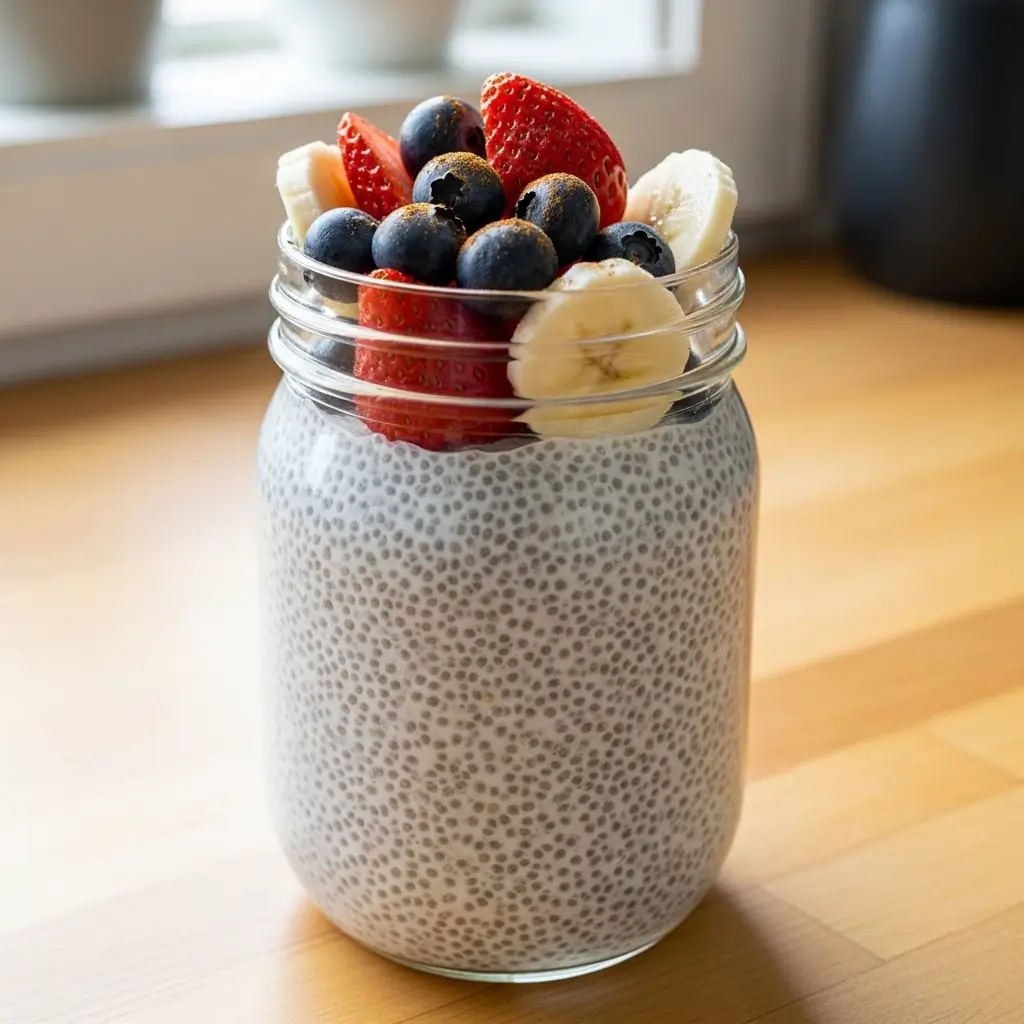
This is the part I wish someone had told me earlier because it genuinely changes how sustainable low calorie chia pudding is as a regular breakfast.
The biggest complaint people have about low calorie breakfasts is feeling hungry an hour later. The solution isn’t always more calories — sometimes it’s about the composition of what you’re eating.
Add protein: The nonfat Greek yogurt I already mentioned — 2 tablespoons for about 10 calories. But you can do more. A full quarter cup of nonfat Greek yogurt stirred through the base adds about 22 calories and roughly 6 grams of protein. That protein matters enormously for satiety. A low calorie chia pudding with protein keeps you full significantly longer than one without.
Use a slightly creamier milk: Cashew milk feels richer than almond milk even at similar calorie counts. Feeling like you’re eating something rich and creamy reduces the psychological sensation of restriction, which matters more than people admit.
Choose high-volume toppings: A big pile of fresh strawberries — like eight or ten medium strawberries — is about 40 calories and looks generous and abundant. Volume matters psychologically. A bowl that looks full feels more satisfying than a bowl that looks sparse even at the same calorie level. Choose toppings that give you visual abundance: berries, sliced kiwi, thin banana slices spread across the top.
Eat it slowly: This sounds obvious and slightly preachy and I’m saying it anyway because I eat everything fast and it genuinely makes a difference. Chia pudding is meant to be eaten with a spoon, thoughtfully, not inhaled while reading your phone. The slower you eat it the more satisfied you feel from the same amount of food. I’m working on this. I’m not fully there yet.
Variations That Stay Low Calorie
Chocolate version: Add 1 teaspoon unsweetened cocoa powder to the base. Zero sugar cocoa powder is about 12 calories per teaspoon. Top with sliced banana and three or four small dark chocolate chips — yes, real chocolate chips, three or four, about 20 calories total, and they make the bowl feel like a treat. Total stays well under 220 calories and it tastes like dessert.
Matcha version: Whisk 1 teaspoon of matcha powder into the almond milk before adding the chia seeds. About 5 extra calories. Top with mango chunks — fresh ripe mango is naturally sweet and about 50 calories per half cup. This is genuinely one of the most beautiful and satisfying versions of low calorie chia pudding I’ve made.
Strawberry base version: Blend 6 or 7 very ripe fresh strawberries into the almond milk before adding the chia seeds. This adds maybe 25 extra calories and the pudding turns pink and tastes like strawberries and cream. My daughter Nour saw this version and demanded I make it for her, which meant I had to explain that sometimes mama’s breakfast looks like dessert and that’s allowed.
Tropical version: Use light coconut milk instead of almond milk, add a tiny pinch of extra cinnamon and a pinch of cardamom, top with kiwi and mango. About 200 calories total. Tastes like a beach vacation. Does not actually take you to a beach. But the feeling is nice.
Coffee version: Replace half the almond milk with cold brew coffee — unsweetened, obviously. The coffee adds essentially zero calories and creates this beautiful mocha-adjacent flavor that makes the low calorie chia pudding feel significantly more sophisticated and slightly energizing. Top with a dusting of cinnamon and a few dark chocolate chips. This is my current Monday morning version because Mondays deserve something special.
Three Months In — What Actually Happened
I’ve been making low calorie chia pudding as my regular weekday breakfast for about three months now. Here’s the honest report.
The jeans cooperated. Not dramatically, not overnight, but they cooperated. Replacing a breakfast that was quietly running 400-plus calories with one that runs 180 to 220 calories, five days a week, adds up. Math is boring but it works.
More than that — and this surprised me — I stopped being as hungry mid-morning as I used to be. I’d assumed that lower calorie meant less filling. It doesn’t, when you do it right. The fiber from the chia seeds, the protein from the Greek yogurt, the fat from even a teaspoon of nut butter — together they do a genuinely effective job of keeping hunger away until lunch.
I also stopped thinking about breakfast as a problem to solve. It’s just there, in the fridge, every morning, already done. That’s worth something. That might actually be worth more than the calorie thing.
Nadia texted me last week to ask how the chia pudding was going. I told her I’d probably made it 60 times since January. She sent back one word: “told you.” She did tell me. The voice note was four minutes long. She was right about all of it.
Make this tonight. Put it in the fridge before you go to sleep. Open it in the morning and add a pile of fresh berries and one careful measured teaspoon of almond butter. Eat it slowly. Tell me in the comments if the jeans cooperate 🥄💚
Table of Contents
Low Calorie Chia Pudding
A genuinely satisfying low calorie chia pudding that comes in at just 180 to 220 calories per serving — made with unsweetened almond or cashew milk, real vanilla, warming cinnamon, and zero-calorie sweetener. Filling enough to last until lunch thanks to chia seed fiber and optional nonfat Greek yogurt protein. Includes five flavor variations to keep weekday breakfasts interesting without blowing your calorie goals.
Ingredients
- 1 cup unsweetened almond milk or unsweetened cashew milk
- 3 tablespoons chia seeds (black or white)
- 1 teaspoon pure vanilla extract
- 1/4 teaspoon ground cinnamon
- Pinch of salt
- A few drops pure liquid stevia OR 1/4 teaspoon monk fruit sweetener (optional, zero calories)
- 2 tablespoons plain nonfat Greek yogurt (optional, approximately 10 calories)
- Fresh strawberries for topping (approximately 40 calories per generous handful)
- Fresh blueberries or raspberries for topping (optional)
- Half a sliced banana for topping (approximately 50 calories, optional)
- 1 tablespoon unsweetened coconut flakes for topping (approximately 18 calories, optional)
- 1 teaspoon almond or peanut butter for topping (approximately 32 calories, optional)
- 1 teaspoon honey for topping (approximately 21 calories, optional)
Instructions
-
Step 1Pour unsweetened almond milk or cashew milk into a wide-mouth mason jar or airtight container.
-
Step 2Add exactly 3 tablespoons of chia seeds, vanilla extract, cinnamon, salt, and zero-calorie sweetener if using. Stir thoroughly, scraping the bottom and sides of the jar to fully combine everything.
-
Step 3Wait exactly 15 minutes, then stir vigorously again for 45 seconds to break up any early seed clusters before they set permanently.
-
Step 4Stir in nonfat Greek yogurt at this point if using, until fully incorporated.
-
Step 5Cover the jar with a lid and refrigerate overnight for best flavor and texture — minimum 6 hours, overnight strongly recommended for lower-fat plant milks.
-
Step 6In the morning check consistency — if too thin add a half tablespoon of chia seeds and refrigerate 30 more minutes. If too thick add a small splash of almond milk and stir.
-
Step 7Add measured toppings of fresh fruit, coconut flakes, and one teaspoon of nut butter just before serving. Do not add toppings the night before.
-
Step 8Serve immediately, eating slowly through the layers. Store remaining jars covered in the refrigerator for up to 5 days.